

Best Coffee Blend for French Press: 7 Top Picks
Last Updated: October 23, 2026
Quick Summary
The best coffee blend for French press depends on your flavor preference, but our House Blend offers a balanced starting point with nutty warmth and clean finish, while medium-dark and dark roasts like the Latin American Blend deliver fuller body and chocolate notes. Success requires a 1:16 coffee-to-water ratio, coarse grind, four-minute steep, and 195-205°F water temperature.
- Use a 1:16 coffee-to-water ratio: 60 grams of coffee to 960 grams of water for a standard 34-ounce French press.
- Grind beans immediately before brewing to a coarse, sea-salt texture using a burr grinder for consistency.
- Steep for exactly four minutes at 195-205°F water temperature, then press the plunger slowly over 30 seconds.
- All seven blends are priced at $21.99 and roasted the day they ship to ensure peak freshness.
- Whole beans stay fresh 2-3 weeks after roasting in an airtight container; pre-ground coffee loses quality within days.
Table of Contents
- Best Coffee Blends for French Press: Quick Comparison
- How We Evaluated These Blends
- Best Coffee Beans for French Press by Roast Level
- French Press Coffee Ratio and Brewing Technique
- Best Pre-Ground Coffee for French Press
- How to Make French Press Coffee That Tastes Great
- Why Freshness and Grind Size Matter Most
- Which Blend Should You Choose?
- Frequently Asked Questions
Best Coffee Blends for French Press: Quick Comparison
The French press is one of the most forgiving brewing methods for rich, full-bodied coffee, but not every best coffee blend for French press delivers the same experience. Its simplicity means bean quality matters far more than equipment complexity.
At DonAntoniosCoffee, we've spent years identifying which blends perform best in a French press. The difference between a muddy, over-extracted cup and a clean, balanced one comes down to roast level, grind consistency, and freshness. This guide covers our seven top picks, how we evaluated them, and how to brew them.
| Blend | Roast Level | Best For | Price |
|---|---|---|---|
| House Blend | Medium | Everyday drinking, balanced profile | $21.99 |
| Breakfast Blend | Medium | Morning ritual, bright and clean | $21.99 |
| Latin American Blend | Medium-Dark | Full body, chocolate and cocoa notes | $21.99 |
| Asian Plateau Blend | Medium | Heavy body, earthy and herbal | $21.99 |
| Cowboy Blend | Dark & Medium Mix | Bold, cocoa and caramel balance | $21.99 |
| 6 Bean Blend | Dark | Complex, espresso-worthy depth | $21.99 |
| French Roast | Dark | Bold, rich, bittersweet finish | $21.99 |
How We Evaluated These Blends
We tested each blend with the same method: a 1:16 coffee-to-water ratio, coarse grind, four-minute steep, and water around 200°F. We tracked extraction behavior, sediment versus clean cups, and how flavor developed as the coffee cooled.

The top blends avoided the two most common French press failures: weak, under-extracted coffee (grounds too coarse or steep too short) and bitter, muddy brews (fine particles slipping through the mesh filter from an inconsistent or too-fine grind).
We also favored forgiving blends that deliver solid results even when water temperature or timing isn't flawless.
Best Coffee Beans for French Press by Roast Level
Roast level shapes how a blend behaves in a French press more than any other factor. Medium roasts highlight origin characteristics and acidity; medium-dark and dark roasts bring out body, sweetness, and chocolate notes while reducing acidity. Neither is objectively "better", it depends on what you want in your cup.
Medium Roasts for Clarity and Balance
Medium roasts shine in a French press because immersion brewing extracts their subtle flavors without burning them. The coarse grind and four-minute steep give them room to develop complexity without becoming harsh.
Our House Blend ($21.99) is the foundation pick. It blends Central and South American beans roasted to medium, delivering nutty warmth with hints of sweet chocolate and a clean, bright finish.
The Breakfast Blend ($21.99) is brighter than the House Blend, with a cleaner finish. South American coffees dominate, chosen for approachable sweetness and low acidity. Many people who think they dislike black coffee find this one approachable.

The Asian Plateau Blend ($21.99) stays medium roast but goes a different direction: heavy-bodied and richly aromatic, with earthy, herbal notes. It works best if you prefer a fuller mouthfeel and don't mind earthy undertones.
Medium-Dark and Dark Roasts for Full Body
Medium-dark and dark roasts are the French press sweet spot for a heavier cup. The darker the roast, the more chocolate, caramel, and cocoa notes intensify while origin characteristics fade and acidity drops.
The Latin American Blend ($21.99) sits at medium-dark, balancing roast character with origin expression: toasted nuts, gentle fruit tones, and a soft cocoa finish.
The Cowboy Blend ($21.99) mixes dark and medium roasted beans for bold character with smoothness. Cocoa and caramel lead, with a whisper of vanilla softening the finish.
The 6 Bean Blend ($21.99) is a meticulous dark roast of six specialty-grade origins, each contributing body, complexity, sweetness, or depth. It's the blend we make for people who take their coffee seriously.
The French Roast ($21.99) is bold and unapologetic, roasted to the edge where smoke softens into something rich and almost sweet. Specialty-grade Central American coffees give it a bittersweet, smooth finish.
French Press Coffee Ratio and Brewing Technique
The best coffee blend for French press can only perform with the right ratio and technique. A French press works through immersion, extracting flavor through time rather than pressure.
Use a 1:16 coffee-to-water ratio as your starting point. That means one gram of coffee to 16 grams of water.
Grind your beans immediately before brewing to a coarse, sea-salt texture. Fine grounds pass through the mesh filter and create sediment and bitterness. Use a burr grinder rather than a blade grinder, which produces inconsistent particle sizes.
Heat water to 195-205°F. Boiling water (212°F) can over-extract and burn the grounds. If you don't have a thermometer, let boiled water cool for about 30 seconds.
Pour a small amount of water to wet the grounds, then wait 30 seconds. This "bloom" allows CO2 to escape and promotes even extraction. Pour the remaining water slowly, ensuring all grounds are saturated.
Steep for four minutes. Set a timer, this is where precision matters. At four minutes, press the plunger down slowly over about 30 seconds. Pouring immediately after plunging prevents over-extraction as the grounds continue to release flavor in the hot water.
Best Pre-Ground Coffee for French Press
Pre-ground coffee loses freshness faster than whole beans because grinding increases surface area and oxygen exposure. For French press, whole beans are always better. If you must buy pre-ground, choose blends ground specifically for French press, coarser than espresso but consistent in particle size.
None of our blends come pre-ground by default. We roast whole beans the day we ship them, prioritizing freshness over convenience, and most customers grind immediately before brewing.
If buying pre-ground, check the grind description: "French press grind" or "coarse grind" is what you need, while "espresso grind" or "fine grind" creates sediment and bitterness. Use pre-ground coffee within two weeks of opening.
How to Make French Press Coffee That Tastes Great
Great French press coffee is less about skill and more about a repeatable process. Here's the exact method we recommend.
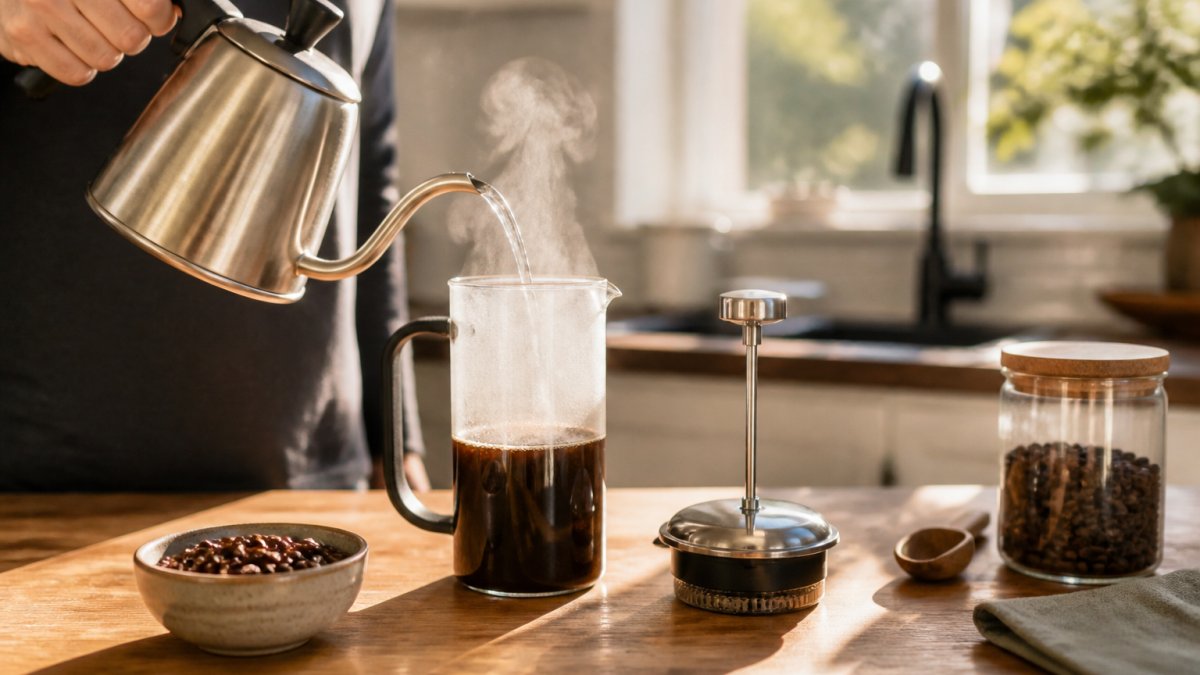
What You'll Need:
- French press (34 oz or larger)
- Burr grinder
- Kitchen scale (optional but recommended)
- Thermometer or kettle with temperature display
- Timer
- Whole-bean coffee
Step 1: Measure Your Coffee [Time: 1 minute]
Use a 1:16 ratio of coffee to water.
Step 2: Grind Your Beans [Time: 2 minutes]
Grind immediately before brewing to a coarse, sea-salt texture on your burr grinder's coarsest setting.
Step 3: Heat Your Water [Time: 5 minutes]
Heat water to 195-205°F. If you have a thermometer or a kettle with a temperature display, use it.
Step 4: Bloom Your Grounds [Time: 30 seconds]
Pour just enough hot water to wet the grounds, about one-quarter of your total water. Let it sit for 30 seconds without stirring.
Step 5: Pour Remaining Water [Time: 1 minute]
Slowly pour the remaining water over the grounds, ensuring all of them are saturated. Pour in a circular motion to avoid creating dry pockets.
Step 6: Steep [Time: 4 minutes]
Let the coffee steep for exactly four minutes. Set a timer. At four minutes, slowly press the plunger down over about 30 seconds. A slow press prevents grounds from being forced through the mesh filter.
Step 7: Pour and Drink [Time: Immediate]
Pour immediately after plunging. Leaving the coffee in the French press after pressing continues extraction and can make the cup taste bitter or muddy.
Expected Result: A clean, full-bodied cup with visible complexity.
Why Freshness and Grind Size Matter Most
Freshness separates good French press coffee from great. Coffee begins losing flavor within days of roasting as volatile compounds escape; after two weeks the difference is noticeable, and after a month most coffee tastes flat.
This is why we roast your beans the day we ship them: you taste the blend as intended, from the citrus notes in our Breakfast Blend to the chocolate depth in the Latin American Blend, all of which fade quickly in older coffee.

Grind size is equally critical. Coarse grounds need the full four minutes to release their flavor; fine grounds over-extract and create bitterness and sediment; medium grounds produce a muddled cup as some particles extract fully while others under-extract.
A burr grinder is worth the investment: blade grinders chop randomly into fine dust and chunky pieces, while burr grinders crush beans between two surfaces for uniform particle size.
Which Blend Should You Choose?
Your choice depends on flavor preference and desired body. Start with our House Blend if unsure: balanced for most palates and bold enough to showcase what a French press can do.
For brightness and clarity, choose a medium roast like the Breakfast Blend (cleaner, more approachable) or Asian Plateau Blend (heavier, more exotic).
All of our blends are roasted the day we ship them and include free shipping in the continental United States, so you get coffee at peak flavor potential, not something sitting in a warehouse for months.
The real test is brewing a cup. French press coffee reveals a blend's true character, with no paper filter to soften the edges and no crema to mask flaws.
Frequently Asked Questions
What roast is best for French press coffee?
Medium and medium-dark roasts work best for French press brewing. Medium roasts highlight origin flavors and acidity, while medium-dark roasts deliver fuller body and richer chocolate or caramel notes. Dark roasts can work but may taste bitter if over-extracted. French press's immersion brewing method suits roasts with balanced acidity and body, avoid very light roasts, which can taste thin and sour in this brew method.
What grind size works best for French press coffee?
Use a coarse grind for French press, similar to breadcrumbs or sea salt. Fine grounds over-extract during the 4-minute steep, causing bitter, muddy brew. Coarse grounds extract properly without settling heavily at the bottom. Grind consistency matters too: uneven grind sizes lead to some particles over-extracting while others under-extract, creating an unbalanced cup.
How much coffee should I use in a French press?
Adjust to taste: more coffee for stronger brew, less for lighter. A kitchen scale ensures consistency and eliminates guesswork.
Should I use a blend or single-origin coffee in a French press?
Both work well in French press. Blends typically offer balanced, approachable flavors and consistent quality cup to cup. Single-origin coffees highlight unique origin characteristics, fruity, earthy, or floral notes, and work beautifully in French press's full-immersion method. Choose based on whether you prefer predictable comfort or exploring distinct flavor profiles.
Can I use pre-ground coffee in a French press?
Yes, but whole beans ground fresh taste noticeably better. Pre-ground coffee loses aromatic oils and flavor compounds within days of grinding. If using pre-ground, buy small quantities and store in an airtight container away from heat and light. Ideally, grind coarse whole beans just before brewing for maximum freshness and flavor.
The difference between mediocre French press coffee and exceptional coffee comes down to freshness, grind consistency, and the right blend for your taste. Hit the button below to try our newest Italian coffee and experience what freshly roasted beans deliver in your French press. We roast the day we ship, so you're tasting coffee at its peak.
