

Are Small-Batch Roasted Coffee Benefits Worth It?
Last Updated: October 30, 2026
Quick Summary
Small batch roasting is worth it if you value control and freshness, since roasters can adjust each run and ship coffee soon after roasting. Large-scale roasters offer more uniform batches and lower cost per pound. Quality depends mostly on the roaster's practices and skill.
- Small-batch roasters can adjust bean color, sound and smell within each batch.
- Roasting in small batches lets roasters tune development time to highlight acidity, sweetness or body.
- Small-batch roasting usually means roughly 1 to 25 pounds of green coffee per roast cycle.
- Small-batch coffee typically costs more per pound because labor and energy are spread over fewer beans.
- Check for a printed roast date, origin details and batch size disclosure when judging a roaster.
Table of Contents
- What Small Batch Roasting Means and Why It Matters
- The Benefits of Small Batch Roasting for Flavor and Quality
- Small-Batch vs. Large-Scale Coffee Roasting: An Evidence-Based Comparison
- How the Small-Batch Coffee Roasting Process Works
- Why Coffee Degassing After Roasting Affects Your Cup
- Small-Batch Coffee Quality Control and Its Limitations
- Trying Small-Batch Roasted Coffee at Home: Your Next Step
- Frequently Asked Questions
What Small Batch Roasting Means and Why It Matters
Small-batch roasting is the practice of roasting coffee in relatively small quantities, usually a few kilograms or less per run, so the roaster can monitor and adjust each batch closely. In a small-batch setting, a roaster typically watches bean color, sound and smell throughout the cycle rather than relying on a fixed profile run after run.
The appeal is control. Larger roasters can produce consistent results at volume, but they often make less room for adjustment mid-roast. Small-batch work lets roasters respond to the particular density and moisture of each lot of green coffee.
The Benefits of Small Batch Roasting for Flavor and Quality
The most cited benefit is flavor development. Because each batch is smaller, heat application is easier to control, which means the roaster can aim for a roast curve suited to that coffee's origin rather than a generic profile.
Several benefits follow from that control:
- Freshness: Beans roasted close to the shipping date reach the customer before they lose aromatic compounds.
- Lower risk of burnt or uneven beans: Smaller loads heat more evenly, which reduces scorched or underdeveloped beans in the same batch.
- Customized roast profiles: Roasters can tune development time to highlight acidity, sweetness or body.
- Closer quality checks: Each batch can be sampled and evaluated before it ships.
Our coffee is roasted the day it ships, so the coffee you brew has spent as little time as possible sitting on a shelf.
Small-Batch vs. Large-Scale Coffee Roasting: An Evidence-Based Comparison
Most comparisons of small-batch and large-scale roasting rely on broad claims. A more useful approach is to define what counts as small versus large and then compare outcomes that can actually be observed: roast consistency, waste, energy use, and freshness at the point of sale.
Defining batch sizes
There is no single industry threshold, but a common working definition is:
- Small-batch: roughly 1 to 25 pounds of green coffee per roast cycle, typically on a drum roaster with direct operator control.
- Mid-scale: roughly 25 to 250 pounds per cycle, often with partial automation and recipe-based profiles.
- Large-scale: hundreds to thousands of pounds per cycle, usually on industrial roasters built for repeatability across long production runs.
These ranges overlap in practice, and a roaster's skill matters more than the number on the machine. Use them as a frame for comparison, not a quality ranking.
Measurable outcomes to compare
Roast consistency. Large roasters excel at batch-to-batch uniformity because airflow, drum speed, and heat input are tightly controlled and repeated. Small-batch roasting introduces more operator variation, which can produce slight differences between batches. The trade-off is that a skilled small-batch roaster can adjust within a batch to correct a drifting curve, while a large roaster typically corrects between batches.
Waste and resource use. Small runs generate less green-coffee waste when a roaster is dialing in a new profile, because fewer pounds are committed to each test. Large runs amortize energy and labor across more pounds, which usually lowers energy use and cost per pound. Neither outcome is universally better; the right comparison depends on whether you are optimizing for experimentation or for volume efficiency.
Freshness at the point of sale. A small-batch roaster who roasts to order can ship coffee within days of the roast date. A large roaster distributing through retail channels may have weeks between roast and shelf. The freshness advantage is real but conditional: it depends on the roaster's shipping practice, not the batch size itself.
Cost per pound. Small-batch production carries higher per-unit costs from labor, energy, and lower equipment throughput. That cost is typically passed to the consumer. Large-scale production spreads those costs across volume.
A buyer who enjoys noticing differences between origins may prefer a small-batch roaster's adjustability. Be skeptical of any claim that small-batch coffee is always superior; the advantage depends on how skillfully the roaster works and how fresh the beans are when they reach you.
The comparison comes down to a few measurable outcomes, and each batch size has its own advantage.
Single Origin Favorites Sample Pack →
| Outcome | Large-scale advantage | Small-batch advantage |
|---|---|---|
| Roast consistency | Uniformity across batches | Adjust within a batch |
| Waste when dialing in | Not stated | Fewer pounds per test |
| Freshness at point of sale | Depends on shipping | Ships within days of roast |
| Cost per pound | Costs spread over volume | Higher per-unit cost |
How the Small-Batch Coffee Roasting Process Works
A typical small-batch run begins with weighing green coffee, then loading it into the roaster and applying heat while monitoring temperature and airflow. As the beans absorb heat, they pass through the drying, browning and development stages. The roaster decides when to stop based on color, sound and time, then cools the beans quickly to halt the roast.
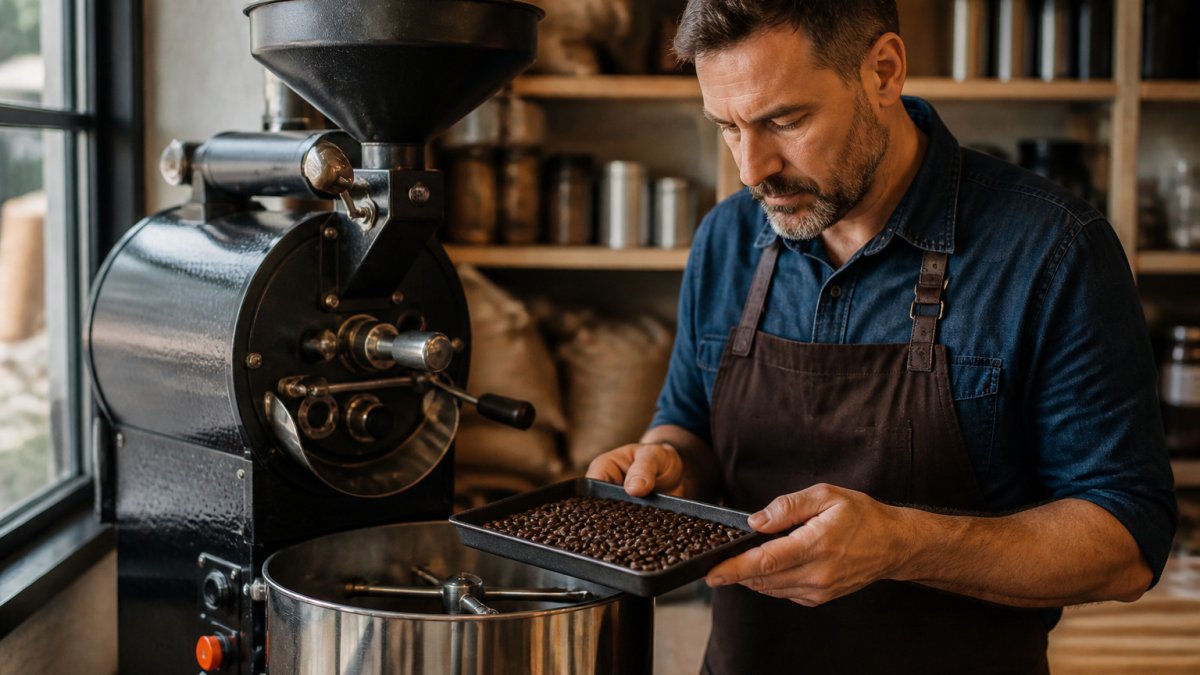
Development time, the interval between the first crack and the end of the roast, has a large effect on flavor. Too short, and the coffee tastes grassy or sour. Too long, and sweetness gives way to bitterness and a flat, ashy finish.
Why Coffee Degassing After Roasting Affects Your Cup
Freshly roasted coffee releases carbon dioxide over the days following roasting, a process called degassing (Carbon monoxide emission rates from roasted whole bean and ground coffee). Degassing matters for two reasons: very fresh coffee can taste sharp or uneven, and beans that have degassed too long lose aromatic intensity.
Most brewers find that a short rest of several days after roasting produces a more balanced cup, though the ideal window varies by bean and brew method. Store roasted beans in an airtight container away from heat and light, and grind shortly before brewing. The roast date printed on the bag is the most useful indicator of where a bag sits in that window.
Small-Batch Coffee Quality Control and Its Limitations
Quality control in small-batch roasting usually means sampling each batch, checking roast color against a reference, and cupping before release. That catches obvious defects, but it is not a substitute for good green coffee. A roaster can only bring out qualities the beans already have.
Real limitations of small-batch roasting
- Higher per-unit cost. Smaller runs spread labor, energy, and equipment time across fewer pounds, which typically raises the price per bag.
- Less batch-to-batch uniformity. Operator judgment introduces variation that large, automated systems minimize.
- Limited availability. Small roasters often sell out of a lot and cannot restock the same green coffee once it is gone.
- Capacity constraints. A small roaster may struggle to fill large or recurring orders on short notice.
- Skill dependence. The quality ceiling is set by the person at the roaster, not by the batch size.
Batch size alone does not guarantee quality. A poorly run small-batch operation can produce worse coffee than a well-run large one.
How to assess a small-batch roaster
Use this checklist when evaluating a roaster's quality practices:
- Roast date, not just a best-by date. A printed roast date tells you how fresh the coffee is. Best-by dates alone are not a freshness indicator.
- Origin and lot details. Look for the country, region, farm or cooperative, varietal, and processing method. Specificity signals that the roaster knows the green coffee.
- Roast profile information. Roast level (light, medium, dark) and any stated development goals help you match coffee to your brewing method.
- Cupping or quality notes. Roasters who publish tasting notes and cupping scores are showing their work; vague flavor adjectives without context are weaker signals.
- Transparent sourcing. Named farms, cooperatives, or import partners indicate a supply chain the roaster can speak to.
- Batch size disclosure. A roaster who states batch size and roast schedule is giving you a verifiable process detail rather than a marketing claim.
- Consistency over time. Ordering the same coffee twice is the simplest test of whether the roaster's quality control holds up.
Consumers should weigh these trade-offs against their own priorities. If you value freshness and origin character, small-batch roasting can deliver it, provided the roaster's practices hold up to the checklist above. If you value uniform flavor and lower cost per pound, a well-run large roaster may serve you better.
Trying Small-Batch Roasted Coffee at Home: Your Next Step
If you want to test whether small-batch roasting makes a difference for you, start with a single origin so you can taste the bean's character on its own. Our Single Origin Favorites Sample Pack ($24.99) includes six 2-ounce bags, each roasted the day it ships, so you can compare origins side by side. The Best Sellers Sample Pack ($24.99) covers blends and single origins if you prefer to start with what most customers choose.

For brewing, a French press brings out body and sweetness, while a drip machine suits everyday coffee. Best coffee blend for French press lists specific picks suited to that method. Our guide to the best coffee blend for French press walks through specific picks suited to that method. If you want to keep trying new coffee regularly, you can also order fresh roasted coffee beans delivered to your door. The Ethiopia Natural ($21.99) and Uganda ($21.99) are single origin options to explore.
Whether small-batch roasting is worth the extra cost is ultimately a question for your own palate. Try a few origins, note what you prefer, and decide from the cup.
Frequently Asked Questions
What does small-batch coffee roasting mean?
Small-batch roasting means a roaster processes a limited amount of green coffee in each run, often a few pounds at a time, rather than the hundreds of pounds typical of large industrial drums. Smaller loads heat more evenly and let the roaster adjust temperature, airflow and timing for each batch. Roasters who work this way can respond to the specific density and moisture of each origin, which is the main reason they can tailor a roast profile to the bean instead of forcing every lot into one standard curve.
Does small-batch roasting make coffee taste better?
It can, but the advantage depends on execution. Smaller batches give roasters closer control over development time and reduce the risk of scorched or underdeveloped beans, which often shows up as cleaner sweetness and clearer acidity in the cup. A poorly managed small roast can still taste flat, so ask whether a roaster tracks roast curves and cups its coffee before judging by batch size alone.
How long should coffee sit after being roasted?
Most roasted coffee benefits from a short rest so CO2 released during roasting, known as degassing, can escape. Many brewers find flavor settles within several days to a couple of weeks after roasting, though the ideal window varies by origin and roast level. Lighter roasts usually need more rest than darker ones. Storing beans in an airtight container away from heat and light helps preserve freshness once the rest period is over.
Is it worth it to buy small-batch roasted coffee?
For many home brewers it is, particularly if fresh flavor and origin character matter to you. Small-batch coffee often costs more per pound than mass-market bags, so the value depends on whether you notice the difference in your cup. Buying a sample pack, such as the Single Origin Favorites Sample Pack at $24.99, lets you compare several origins before committing to a larger bag.
