

Fresh Roasted vs Grocery Store Coffee: Which Wins?
Last Updated: November 4, 2026
Quick Summary
Fresh roasted coffee is roasted shortly before it ships, so it tastes brighter and more aromatic than grocery store coffee, which is often weeks or months old. Check the roast date rather than the brand name, since older beans lose aromatic compounds over time.
- Check the roast date on the bag, since best-by dates do not show when beans were roasted.
- Freshly roasted coffee releases carbon dioxide for several days after roasting, a process called degassing.
- Buy whole beans and grind just before brewing to keep flavor longer.
- Compare cost per cup, not cost per bag, using your actual dose in grams.
- Store opened coffee in an airtight container away from heat, light and moisture, not in the fridge or freezer.
Table of Contents
- Fresh Roasted vs Grocery Store Coffee: What Actually Differs
- Why the Roast Date Matters More Than the Brand
- How to Tell If Coffee Beans Are Fresh Before You Buy
- A Fair Taste Comparison: What Changes in the Cup
- Whole Beans vs Ground Coffee: Freshness Trade-Offs
- Cost Per Cup and Where Your Money Goes
- Storing Your Coffee So It Stays Fresh After Opening
- Choosing Your Next Bag: Start With a DonAntoniosCoffee Sample Pack
- Frequently Asked Questions
Fresh Roasted vs Grocery Store Coffee: What Actually Differs
Fresh roasted coffee and grocery store coffee differ most in age, packaging and how much you pay per cup. At DonAntoniosCoffee, we roast our beans the day they ship, so every bag reaches you while the coffee is still close to its peak.
Freshness is the main difference, but it is not the only one. Sourcing, grind, storage and brewing method all shape the cup. We cover each of these below so you can judge the trade-offs yourself rather than take our word for it.
Here is a quick summary of the core differences:
| Factor | Fresh Roasted (DonAntoniosCoffee) | Typical Grocery Store Coffee |
|---|---|---|
| Roast timing | Roasted the day it ships | Often weeks or months old |
| Buying channel | Direct to your door | Shelf purchase |
| Price per 12 oz bag | From $21.99 | Varies widely by brand |
| Roast date printed | Not shown on product pages | Often missing or hard to find |
Why the Roast Date Matters More Than the Brand
Roast date tells you more about flavor than brand name does. Coffee begins to lose its aromatic compounds soon after roasting, and the effect builds over weeks. A well-known brand with an old roast date can taste flatter than a lesser-known bag roasted recently.
Freshly roasted coffee also releases carbon dioxide for several days after roasting, a process called degassing.
Because brand names say little about freshness, we suggest checking the roast date first. For a fuller explanation, see our guide on coffee roast date importance.
How to Tell If Coffee Beans Are Fresh Before You Buy
Look for a roast date on the bag, and treat "best by" dates with caution. A best-by date tells you when the seller expects quality to decline, not when the beans were roasted.
Check the beans themselves. Fresh whole beans look dry and have a consistent color. Visible oil on the surface can signal a darker roast, but it can also mean the beans have aged. Smell the bag when you open it. Fresh coffee has a clear aroma, while stale coffee often smells flat or like cardboard.
For a complete checklist, read how to tell if coffee beans are fresh before your next purchase.
A Fair Taste Comparison: What Changes in the Cup
Taste differences between fresh and older coffee are real, but they are easy to overstate. The only way to separate freshness from roast level, bean quality and brewing skill is to control every variable except age. Most comparisons fail because they change two or three things at once.
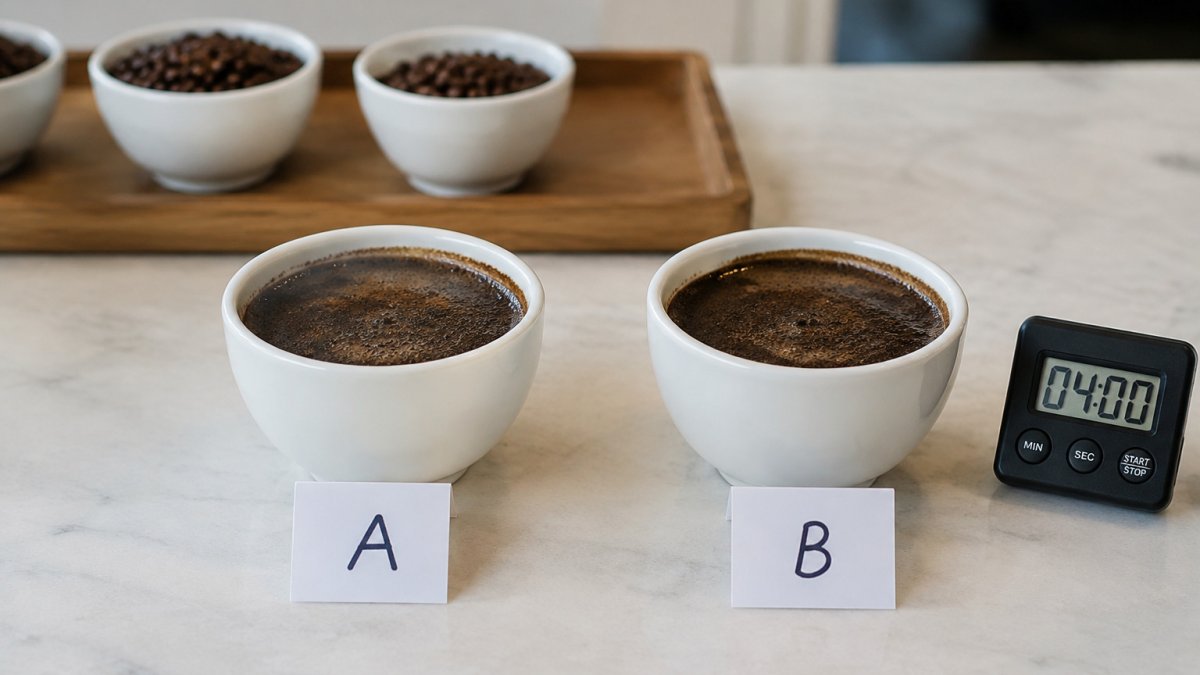
Here is a controlled method you can run at home:
- Use the same coffee. Buy two bags of the same coffee from the same roaster, roasted on the same day. Freeze one bag immediately in an airtight container. Leave the other bag out at room temperature in its original packaging. After four to six weeks, thaw the frozen bag overnight in the sealed container and brew both side by side.
- Hold the recipe constant. Same dose (weigh it, don't scoop), same grind setting, same water temperature, same brew ratio, same brew time, same cup. If you change the grind or the dose between cups, you are tasting the recipe, not the age.
- Brew blind. Have someone else label the cups A and B and don't reveal which is which until you've written down your impressions. Expectation is a powerful seasoning.
- Taste at the same temperature. Aromatics read differently at 160°F than at 120°F. Slurp, wait, and taste again as the cup cools.
- Score specific attributes. Note aroma intensity, acidity, sweetness, body, finish length and any off-flavors (papery, cardboard, flat, woody). "Better" is too vague to be useful.
When that test is run carefully, freshly roasted coffee usually shows brighter aroma and more distinct tasting notes. Older coffee tends to taste flatter and more muted, and the finish shortens first. Many people find the difference clearest in lighter roasts, where delicate floral and fruit notes fade fastest, and least obvious in dark roasts, where roast character dominates.
Resting windows change the comparison. A bag roasted yesterday is not at its best today. The ideal resting window varies by coffee and brew method. Espresso often needs a longer rest than filter because trapped CO2 disrupts extraction. If you compare a two-day-old light roast against a six-week-old bag, you may be measuring degassing, not staleness.
Your own palate matters too. If you take milk, sugar or strong flavorings, you may notice the difference less. Try a simple side-by-side test at home before deciding the premium is worth it.
Whole Beans vs Ground Coffee: Freshness Trade-Offs
Whole beans keep their flavor longer than ground coffee because less of the surface is exposed to air. Ground coffee can lose aroma within a short time after grinding, so grinding just before brewing makes a noticeable difference.
If you own a grinder, buy whole beans and grind as you brew. If you do not, pre-ground coffee is still usable, but store it carefully and use it within a shorter window. Matching the grind size to your brew method, from coarse for French press to fine for espresso, also matters.
Cost Per Cup and Where Your Money Goes
Price per bag can mislead. A cheaper grocery bag may look like better value until you account for how much you brew, how much you dose and how much you waste. The useful number is cost per brewed cup you actually drink.
The math is simple: cost per cup = bag price ÷ (bag weight in grams ÷ dose in grams). A 12 oz bag holds about 340 grams. At a 20-gram dose, that is roughly 17 brewed cups per bag. At a 15-gram dose, it is about 22 cups. Dose size alone swings cost per cup by nearly 30 percent, which is why comparing bag prices across brands tells you almost nothing.
Run the numbers on a 12 oz bag of DonAntoniosCoffee House Blend at $21.99. At a 20-gram dose, that works out to roughly $1.29 per cup before shipping. At a 15-gram dose, it drops to roughly $0.97 per cup. Read the full article on small-batch roasting costs to see whether the premium fits your budget.
Waste is the hidden line item. Stale coffee you dump has no value, so a fresher bag you finish can cost less per cup you actually enjoy. Factor in shipping too: a flat shipping fee spread across one bag is a real per-cup cost, while spreading it across a multi-bag order lowers it.
A practical way to compare: track how many cups you brew from each bag and how many grams you dose. After two bags you will have a real cost-per-cup figure for your own kitchen, not a marketing claim.
Watch out: don't compare a 12 oz specialty bag against a 24 oz commodity bag by sticker price alone. Convert both to cost per gram first, then to cost per cup at your actual dose, or the comparison will favor whichever bag is bigger.
Compare cost per cup, not cost per bag, before deciding.
Storing Your Coffee So It Stays Fresh After Opening
Once opened, coffee begins to lose freshness quickly. Keep beans in an airtight container, away from heat, light and moisture. Avoid storing coffee in the refrigerator or freezer, where condensation can damage the beans each time you open the container.
Buy only what you expect to use within a few weeks. Portion beans into smaller containers if you buy in bulk, so you expose less coffee to air each time. Keep the original bag if it has a one-way valve, and press out excess air before resealing.
Choosing Your Next Bag: Start With a DonAntoniosCoffee Sample Pack
If you want to compare flavors before committing to one bag, a sample pack is a practical starting point. The Best Sellers Sample Pack ($24.99) includes 6Bean, Cowboy, Breakfast, Peru, Mexico and Bali coffees in 2 oz packs, roasted the day they ship. It lets you taste several roasts side by side at home.

If you prefer flavored coffee, the Flavored Coffees Sample Pack is another way to test options without buying a full bag. Either pack is a low-commitment way to decide whether fresh roasted coffee is worth the switch for you.

For a single everyday option, the House Blend is a medium roast with nutty, chocolate notes, priced at $21.99.

Frequently Asked Questions
Is fresh roasted coffee actually better than grocery store coffee?
In most side-by-side tastings, freshly roasted beans show brighter aroma and more distinct flavor than coffee that has sat on a shelf for months. Grocery store coffee is not always stale, though, because many packages carry no roast date and their age is unknown. The practical test is to check the roast date and compare two cups brewed the same way. Freshness mainly affects aroma and clarity of flavor, so the difference is easiest to notice in the first few weeks after roasting.
How long does coffee stay fresh after opening the bag?
Once opened, whole beans lose aroma faster because air and moisture speed up oxidation. Most people get the best flavor within a few weeks of opening, while ground coffee fades much faster, often within days. Keep the bag sealed tightly, store it away from heat and light, and avoid moving beans between warm and cold places. Buying smaller bags you can finish within a few weeks helps more than any storage trick.
Does the roast date on a coffee bag really matter?
Yes. The roast date tells you how old the beans are, which is more useful than a best-by date, since best-by dates are often set far into the future. Beans taste best at different points after roasting, depending on the roast level and brew method. Look for a roast date printed on the bag rather than relying on a vague freshness claim.
Is fresh ground coffee better than store-bought coffee?
Freshly ground coffee generally has more aroma than pre-ground coffee because the surface area is exposed to air only at the moment of brewing. Pre-ground grocery coffee loses flavor compounds quickly after grinding, so the same beans taste flatter after a week or two. Grinding whole beans just before brewing with a burr grinder gives the most consistent result. If you do not own a grinder, buy the smallest bag you will finish quickly so the grounds do not sit long.
